Framework for AI Implementation
PRACTITIONER BRIEF
Lina Sonne Vyas
5/5/2026
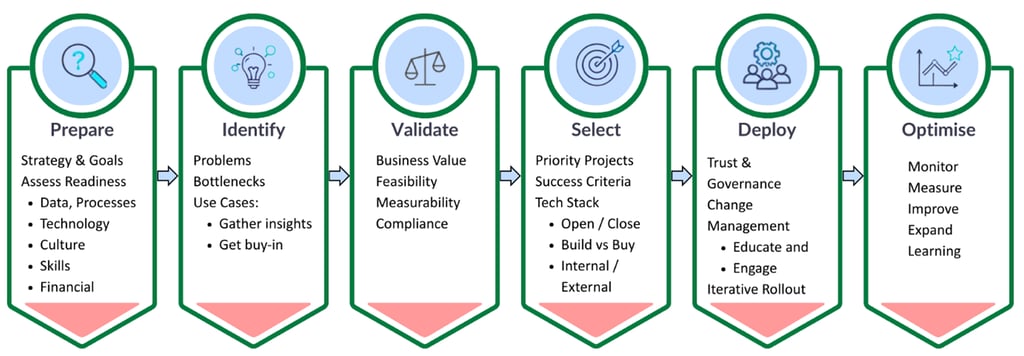
This framework offers a hands-on guide to think through the implementation of GenAI solutions in a company, from preparation to ideation, validation, selection, deployment and maintenance. This framework draws on insights from literature together with interviews we undertook as well as the executive education training and consulting we have provided over the past year. We also draw on established business process improvement and change management principles to ground the framework. It is detailed in our white paper GenAI for Business: Insights from India.
1. Prepare
The first step is to gain clarity on the strategy and goals that the business has, and to assess internal readiness by reviewing organisational data and processes, technology, organisational culture, skills and finances.
Senior leadership must identify strategic and business focused imperatives for GenAI implementation: whether the primary objective is to, for example, drive revenue through improved sales forecasting, decrease operational costs via automated processing, or enhance efficiency by streamlining repetitive workflows. Businesses need to assess the organisational infrastructure and capabilities to understand the level of readiness. These include: quantity, quality and availability of data; clear processes and workflows; technological compatibility with modern cloud-based architectures; organisational culture open to change and AI implementation and availability of internal champions to lead the transition; sufficient skill levels and willingness to upskill for Al and financial capability to invest in AI.
The preparation phase culminates in a clear, quantifiable objective that aligns AI deployment with the overarching corporate strategy, and an understanding of available infrastructure and capabilities to drive projects.
2. Identify
Step two involves identifying possible problems and bottlenecks by gathering insights from across the business. The result should be a list of potential AI use cases as well as cross-organisational buy-in for implementation.
This stage demands an inclusive, cross-functional approach where leadership gathers insights from across departments, functions and levels to pinpoint problems and bottlenecks that can be solved or reduced through AI. By hosting structured problem-finding workshops across organisational levels, executives can surface use cases that may not have been immediately obvious to senior leaders. This is also a chance to gain buy-in from employees to give them a sense of ownership of the process and reduce fear of change – a common challenge in AI implementation.
The objective is to generate a comprehensive list of potential use cases or projects, ensuring that initiatives are grounded in the operational realities of the organisation, and have the necessary buy-in from stakeholders across the hierarchy.
3. Validate
The third step involves assessing the business value that each shortlisted AI project would bring against the technical and regulatory feasibility.
To validate the potential projects, it is essential to evaluate each proposal using measurable criteria, typically by scoring the potential impact on profitability and customer experience against the ease of implementation. This assessment must consider the availability of high-quality data, the maturity of existing technology, and the complexity of the regulatory landscape governing the specific application. By mapping these projects onto a quadrant of business value vs level of complexity, the organisation can distinguish between 1) 'low-hanging fruit'-projects that offer returns with manageable risk; 2) low feasibility and low value projects not worth considering; 3) high-complexity initiatives that require excessive resources; 4) high-impact, high-feasibility initiatives that allow the business to secure early wins and demonstrate the efficacy of AI without overextending resources.
The outcome of this phase should be a clear understanding of the complexity and feasibility of each proposed project.
4. Select
In the fourth step, leadership should choose a pilot project and define its success criteria; and decide on the tech stack and the mode of deployment such as through internal resources, off-the shelf or via external consultants.
In the selection phase the business must narrow the focus to a pilot project, resisting the temptation to pursue multiple disparate initiatives simultaneously. This prioritisation requires defining success criteria that are specific, measurable, and achievable within a three-to-six-month window, ensuring the project is safe enough to serve as a test case without risking core business continuity. Crucial to this step is the determination of the tech stack and the 'build versus buy' decision: Should you leverage existing software-as-a-service (SaaS) tools or integrate AI features within current platforms or build bespoke projects from scratch. Executives must decide whether to utilise internal talent or seek external consultants to manage the implementation, ultimately selecting a pilot that provides a clear 'before and after' metric to validate the investment and serve as a blueprint for future scaling.
At the end of this phase, the company should be ready with an AI implementation plan including the technology, the timeline and internal teams as well as external partners.
5. Deploy
The deployment step shifts the focus from strategic planning to the complexities of change management and operational governance as the pilot project is rolled out in an iterative manner.
Successful execution depends on CXO level internal champion, a dedicated project lead, and clear sign-off mechanisms, to manage the technical rollout. Ideally, subject matter experts who understand the nuances of the daily workflows that are being transformed should be on hand. It is vital to address employee apprehensions by framing AI as a tool for human augmentation rather than replacement, emphasising its role in removing mundane tasks to allow for higher-value work, and offering opportunities to upskill. The implementation should follow a phased approach, beginning with a proof of concept to test the tool against real-world data before committing to a full-scale rollout.
By prioritising education, engagement, and iterative testing, leadership can ensure that the technology is integrated into the organisational fabric while minimising disruption to ongoing operations, and ensuring that employees become comfortable working with AI.
6. Optimise
The final step is to optimise and scale deployment by monitoring performance, measuring the success of the AI solution, and continuously learn and improve.
AI systems are dynamic and require ongoing supervision to ensure sustained performance and ethical alignment. Once the pilot is live, leadership must monitor the pre-defined metrics to quantify the return on investment and communicate these successes to build momentum across the company. Maintenance and optimisation involves a proactive approach to governance, where human oversight is utilised to detect model drift and reduced AI accuracy over time, and to mitigate any potential algorithmic biases that could lead to unwelcome outcomes. As the organisation gains confidence, the focus shifts toward upskilling the workforce and scaling and expanding AI solutions.
By establishing a continuous feedback loop and a robust governance structure, senior leaders can ensure the AI infrastructure remains resilient, transparent, and high-performing.